AgiBot Genie G1智元 Genie G1
Differential-drive base, a waist that lifts and pitches, two 7-DoF arms with OmniPicker grippers, head, chest and wrist cameras. Not the Unitree G1.差速底盘、可升降俯仰的腰部、两条 7 自由度机械臂配 OmniPicker 夹爪,头部、胸部与腕部相机。不是宇树 G1。
AgiBot Genie G1 · MuJoCo · cuRobo · MuJoCo Warp
Indoor mobile manipulation in simulation for the AgiBot Genie G1: generated scenes, reusable skills, multi-camera datasets and benchmarks. 智元 Genie G1 室内移动操作仿真:自动生成场景、可复用技能、多相机数据集与分级评测。
episodes succeeded with the physics of all 8 worlds on one GPU 个 episode 全部成功,8 个世界的物理都在同一块 GPU 上
per batched GPU physics step, 4.7 worlds per step on average 每个批量 GPU 物理步,平均每步合并 4.7 个世界
ingested assets from 7 open datasets 个已接入资产,来自 7 个开放数据集
tests passing on a clean checkout 个测试在干净检出上通过
Pipeline流程
Describe a room, get a validated scene, let the robot work in it with tested skills, and keep every episode as multi-camera data. 描述一个房间,得到经过校验的场景;机器人用经过测试的技能在其中工作,每个 episode 都保存为多相机数据。
A sentence becomes a room: semantic plan (rule-based or LLM), asset retrieval, constraint layout, settling and docking checks.一句话变成一个房间:语义规划(规则或 LLM)、资产检索、约束布局、静置与停靠位检查。
The room's scene graph yields candidate tasks; every skill call is tracked as predicate changes such as on, inside and open.由房间的场景图生成候选任务;每次技能调用都记录为 on、inside、open 等谓词的变化。
Navigation, waist, picks, carry, place, door pull / push / brace, insertion, stance search and head gaze; arm motions planned with cuRobo.导航、腰部、抓取、搬运、放置、拉门 / 推门 / 抵门、插入、站位搜索、头部注视;机械臂运动由 cuRobo 规划。
MuJoCo on the CPU, or MuJoCo Warp on the GPU with many worlds batched by one physics server.CPU 上的 MuJoCo,或 GPU 上的 MuJoCo Warp:由一个物理服务进程批量推进多个世界。
cctv, head and wrist videos, a 25-D state, a 22-D action and the skill stage of every frame.cctv、头部与腕部视频,25 维状态、22 维动作,以及每一帧的技能阶段。
A difficulty ladder (L6 is a draft): binary success per episode, Wilson intervals, classified failures.难度阶梯(L6 为草案):每个 episode 二值成功、Wilson 置信区间、失败分类。
Policies trained on the recorded datasets and evaluated on the benchmark protocol.用录制的数据训练策略,并按评测协议评估。
Capabilities能力
Differential-drive base, a waist that lifts and pitches, two 7-DoF arms with OmniPicker grippers, head, chest and wrist cameras. Not the Unitree G1.差速底盘、可升降俯仰的腰部、两条 7 自由度机械臂配 OmniPicker 夹爪,头部、胸部与腕部相机。不是宇树 G1。
Pick a bottle, open the microwave door with the left hand, insert the bottle with the right. Stance search scores base poses in the running simulation; door skills pull, push and brace. A cabinet variant exists but is not validated yet.抓起瓶子,左手打开微波炉门,右手把瓶子放进去。站位搜索在运行中的仿真里评估底盘位姿;开门技能支持拉、推、抵。柜门变体已有,但尚未验证。
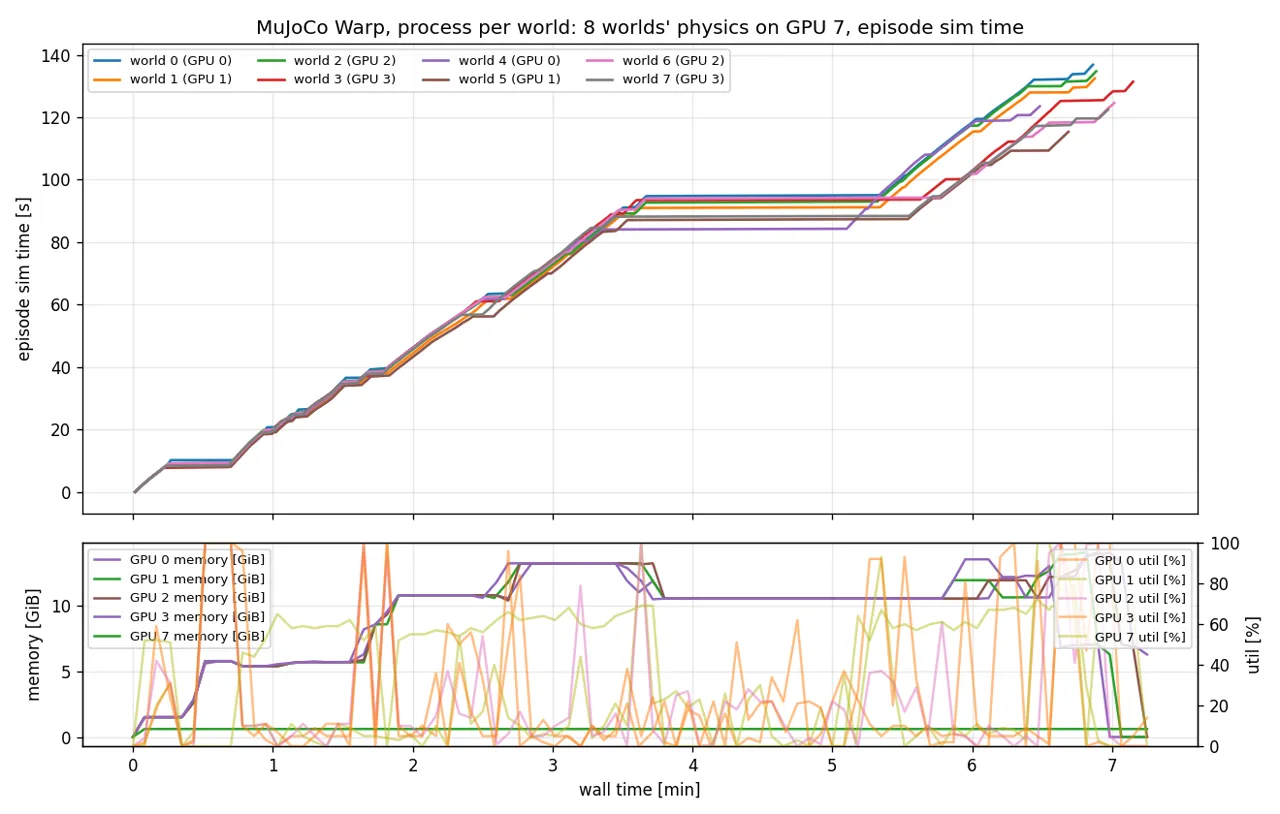
One process per world keeps the single-world stack that already works; a physics server batches all worlds on one GPU. 8 of 8 episodes succeeded.每个世界一个进程,沿用已经跑通的单世界代码;物理服务进程在一块 GPU 上批量推进所有世界。8 个 episode 全部成功。
Ingestion spec v0.1 for mesh, MJCF, URDF, SDF and USD sources. Assets from Google Scanned Objects, RoboCasa, YCB, MolmoSpaces, ArtVIP, robosuite and GAPartNet, searchable by the scene generator.资产接入规范 v0.1,支持网格、MJCF、URDF、SDF、USD 来源。资产来自 Google Scanned Objects、RoboCasa、YCB、MolmoSpaces、ArtVIP、robosuite 和 GAPartNet,可供场景生成器检索。
Rope objects built with MuJoCo's elasticity plugin and a rope-lift task with a physical pinch and lift, with privileged centreline data per frame. Material parameters are not calibrated yet.用 MuJoCo 弹性插件构建的绳索物体,以及物理夹持、提起的提绳任务,逐帧记录特权中心线数据。材料参数尚未标定。
Every episode: a follow-camera video with head, wrist and cctv picture-in-picture and a live skill panel, a ghost-trail image, a JSON log with timing, and a LeRobot v2 style episode.每个 episode 都产出:带头部、腕部、cctv 画中画和实时技能面板的跟随视频、残影图、带耗时的 JSON 日志,以及 LeRobot v2 风格的 episode。
Architecture架构
8 world processes · GPUs 0–38 个世界进程 · GPU 0–3
1 physics server · GPU 71 个物理服务进程 · GPU 7
Each world runs in its own process with its own interpreter, cuRobo planner with CUDA graphs and EGL renderer: exactly the single-world setup that already works. Only the physics state crosses a pipe, about 1 KB per step, to a single-threaded physics server that batches the worlds waiting at that moment into one CUDA-graph step of MuJoCo Warp.每个世界运行在独立进程里,拥有自己的解释器、启用 CUDA 图的 cuRobo 规划器和 EGL 渲染器,与已经跑通的单世界配置完全相同。只有物理状态(每步约 1 KB)通过管道发给单线程的物理服务进程,由它把当时正在等待的世界合并成一次 MuJoCo Warp 的 CUDA 图步进。
Planning and rendering need about 7 GiB per world, so the world processes spread over GPUs 0–3 while the physics of all eight worlds stays on GPU 7 at 0.6 GiB.规划和渲染每个世界约需 7 GiB 显存,所以世界进程分布在 GPU 0–3 上,而 8 个世界的物理始终在 GPU 7 上,只占 0.6 GiB。
8 episodes took 435 s, against 415 s for 8 CPU-physics processes on the same 4-core machine. The run is CPU-bound: GPU batching buys headroom (1.75 ms per batched step, physics GPU idle 39% of the time), not speed per world.8 个 episode 用时 435 s,同一台 4 核机器上 8 个 CPU 物理进程为 415 s。这次运行受 CPU 限制:GPU 批量化带来的是余量(每个批量步 1.75 ms,物理 GPU 有 39% 的时间空闲),而不是单个世界的提速。
Gallery展示
Results结果
Bimanual microwave task. An episode succeeds when the bottle is placed inside and the robot-stability monitor reports no failure (base tilt above 5° for 0.2 s, or 15° and more). 双臂微波炉任务。一个 episode 判为成功,需要瓶子放进微波炉,并且机器人稳定性监测没有报告失败(底盘倾斜超过 5° 持续 0.2 s,或达到 15° 及以上)。
| Run运行 | Physics物理 | Seeds种子 | Result结果 |
|---|---|---|---|
| 0.5× microwave, randomized bottle pose and robot start0.5 倍微波炉,随机化瓶子位姿和机器人起点 | CPU | 0–15 | 15/16 in one batch; the 16th crashed without a result and succeeded on rerun; max tilt 4.35°(同一批);第 16 个崩溃、没有结果,重跑后成功;最大倾斜 4.35° |
| Furnished microwave room布置齐全的微波炉房间 | CPU, one process per seedCPU,每个种子一个进程 | 0–7 | 8/8 |
| Furnished microwave room布置齐全的微波炉房间 | MuJoCo Warp, 8 worlds on one GPUMuJoCo Warp,8 个世界在一块 GPU 上 | 0–7 | 8/8 |
| Single episode, 2026-10-11, furnished room单个 episode,2026-10-11,布置齐全的房间 | CPU | 0 | success成功 bottle inside, door at 37.7°, max tilt 0.88°, 1,424 frames瓶子在微波炉内,门开 37.7°,最大倾斜 0.88°,1,424 帧 |
Sample sizes are small; these are validation runs, not success rates. The cabinet variant, training and evaluation are not validated or not built yet.样本量较小;这些是验证运行,不是成功率统计。柜门变体尚未验证,训练和评测尚未实现。
Team团队
Since October 2026 the team develops directly on main: small commits that carry their tests and evidence, reviewed after they are pushed. The repository is private; team members can ask the project owner for access.从 2026 年 10 月起,团队直接在 main 上开发:小而清晰的提交,附带测试与证据,推送后由其他成员评审。代码仓库是私有的,团队成员可向项目负责人申请访问权限。